
Every business owner understands the importance of controlling costs, protecting profits and keeping operations running smoothly. Yet one of the most easily overlooked threats to a business is surprisingly simple. Forgetting an important renewal date.
An expired insurance policy, an overlooked employee qualification or an overdue equipment inspection might seem like a small administrative mistake. However, depending on the circumstances, these oversights can lead to unexpected expenses, interrupted work, lost contracts and potentially serious legal consequences.
The problem is that business renewals rarely arrive one at a time. Insurance policies, licences, training certificates, vehicle documentation and equipment inspections all follow different schedules. As a company grows, the number of important dates increases, making it harder to keep everything under control.
For UK businesses, effective renewal management is not simply about keeping paperwork organised. It is an important part of protecting revenue, reducing unnecessary risk and maintaining business continuity.
Understanding the hidden costs of missed renewals is the first step towards preventing them.
Why Businesses Miss Important Renewal Deadlines
Most missed renewals are not caused by deliberate negligence. They happen because business owners and managers are busy dealing with immediate demands.
A construction company might be concentrating on completing a major contract. A transport business may be managing vehicle schedules and customer deliveries. A property management company could be handling maintenance requests across numerous buildings.
Meanwhile, important renewal dates continue approaching.
Many businesses still depend on spreadsheets, paper diaries, individual calendar reminders or information stored in employee email accounts. These methods can work reasonably well when there are only a few records to monitor, but they become increasingly unreliable as responsibilities expand.
Another common problem is unclear ownership. One employee assumes the office administrator is arranging an insurance renewal, while the administrator believes the company director is handling it. Without a clearly assigned responsibility, the deadline can pass unnoticed.
The difficulty becomes even greater when employees leave, business locations expand or documents are stored across multiple systems.
A missed renewal is therefore often a symptom of a wider administrative problem rather than an isolated mistake.
1. Expired Business Insurance Can Create Serious Financial Exposure
Insurance is one of the most important areas where businesses must maintain accurate renewal records.
Commercial insurance policies protect organisations against different risks, including property damage, liability claims and business interruption, depending on the cover purchased.
When a policy expires without appropriate replacement cover, a business may be exposed to financial losses that could otherwise have been insured.
For example, imagine a contractor whose public liability insurance has expired. If an incident occurs during the uninsured period, the business could face significant costs depending on the circumstances and its legal responsibilities.
Certain types of insurance are also legally required.
In Great Britain, most employers must have employers liability insurance providing at least £5 million of cover from an authorised insurer, although exemptions apply. The government states that failure to maintain required cover can result in fines of £2,500 for every day the business is not properly insured.
These requirements demonstrate why insurance renewal dates should never be treated as ordinary administrative reminders.
Businesses should maintain clear records of their policies, renewal dates, insurers and relevant documentation. They should also check that their cover remains appropriate for their activities.
2. Expired Employee Qualifications Can Interrupt Work
Employee training and professional qualifications are another major area of risk, particularly in industries where certain activities require specific competence, authorisation or certification.
Construction, engineering, manufacturing, transport and specialist maintenance businesses often employ workers with different training requirements.
Depending on the role and applicable rules, employees may need to maintain relevant qualifications, licences, competency records or certifications.
When an important qualification expires, the consequences may extend beyond the cost of arranging another training course.
An employee might be unable to perform particular duties until the issue is resolved. This could affect staffing arrangements, delay projects or require another qualified worker to take over.
Consider a contractor scheduled to begin a project requiring several workers with particular certifications. If the business discovers shortly before work starts that an essential qualification is no longer current, it may need to rearrange personnel or delay certain activities.
The resulting disruption could be considerably more expensive than the administrative effort required to monitor the renewal in advance.
Businesses should therefore maintain accurate workforce qualification records and regularly review any dates that affect employees’ eligibility or competence to undertake specific tasks.
Importantly, not every qualification has a universal expiry date. Employers must understand the particular requirements that apply to each role and certificate.
3. Overdue Equipment Inspections Can Lead to Operational Disruption
Businesses that rely on machinery and specialist equipment face additional responsibilities involving maintenance, inspections and safe operation.
In the UK, the Provision and Use of Work Equipment Regulations 1998, commonly known as PUWER, establish important duties relating to work equipment.
Certain lifting equipment is also subject to the Lifting Operations and Lifting Equipment Regulations 1998, known as LOLER.
These requirements can involve appropriate maintenance, inspections, thorough examinations and record keeping, depending on the equipment and circumstances.
For businesses using lifting equipment, missed examination deadlines can become particularly problematic.
Imagine a company preparing to use lifting equipment on a busy construction project. If the business cannot establish that the required examination has been completed, it may need to suspend the relevant activity until the equipment’s status has been properly assessed.
That interruption can affect the entire project schedule.
Workers may be unable to continue their planned tasks, additional equipment might need to be sourced and customer commitments could become harder to meet.
The cost of lost productivity may exceed the price of arranging the necessary examination.
Accurate equipment records and advance planning are therefore essential parts of responsible asset management.
4. Missed Vehicle Renewals Can Affect Daily Operations
For businesses operating commercial vehicles, administrative oversights can quickly become operational problems.
Vans, cars and other business vehicles may have several important dates associated with them, including MOT requirements, insurance policies and relevant vehicle tax obligations.
Maintenance schedules and other requirements may also apply depending on the vehicle type and how it is used.
A company with only one van may find these dates relatively easy to remember. However, managing a fleet of ten, twenty or fifty vehicles introduces a completely different level of complexity.
Each vehicle has its own records and responsibilities.
If a vehicle cannot legally or safely be used because a relevant requirement has not been met, the business may need to rearrange deliveries, reschedule employees or find replacement transport.
This can affect customer service and profitability.
For contractors and service businesses, even one unavailable vehicle can create serious inconvenience when employees depend on it to reach customers or transport equipment.
Maintaining a central register of vehicles, documentation and renewal dates can help businesses identify upcoming obligations and arrange necessary action in advance.
5. Missed Contract Renewals Can Damage Profitability
Not every costly renewal mistake involves insurance, safety or legal obligations.
Commercial contracts and supplier agreements can also have significant financial consequences.
Many businesses enter into agreements covering software, equipment hire, telecommunications, maintenance services, property arrangements and other recurring expenses.
Some contracts include automatic renewal provisions, notice periods or conditions governing cancellation.
Failing to review these arrangements before a relevant deadline can leave a business committed to terms it might otherwise have renegotiated or discontinued.
For example, a company may continue paying for software that employees rarely use simply because nobody reviewed the subscription before its renewal date.
A supplier agreement might also renew at a higher price when the business could have explored alternative arrangements.
These costs can accumulate over time.
A sensible contract management process should therefore record not only the expiry or renewal date, but also any applicable notice periods and the person responsible for reviewing the agreement.
The earlier a business identifies an upcoming contractual deadline, the more opportunity it has to consider its options.
6. Missing Documents Can Cost Businesses Valuable Opportunities
A business may have valid insurance, qualified employees and properly inspected equipment, yet still encounter problems if it cannot produce the relevant documentation when requested.
This is particularly important in industries where customers, principal contractors or commercial partners require evidence of particular qualifications, certifications or insurance cover.
A business bidding for a contract may need to supply supporting documents within a specified timeframe.
If important records are scattered across filing cabinets, personal computers and email accounts, assembling the information can become unnecessarily difficult.
In some circumstances, delays in providing required evidence may affect a tender submission or postpone the start of work.
This means effective document management has commercial value beyond simple organisation.
Businesses should know where essential records are stored, whether they are current and who is responsible for maintaining them.
A well organised digital document system can help make this information easier to access when needed.
The Real Cost Goes Beyond Fines and Fees
When discussing missed renewals, it is tempting to focus entirely on financial penalties. However, direct fines and renewal fees are only part of the picture.
There are several other costs that businesses should consider.
Administrative time is one. Employees may spend hours investigating missing documents, contacting providers, arranging urgent appointments or resolving problems that could have been identified earlier.
Operational disruption is another. A delayed project, unavailable employee or unusable piece of equipment can affect productivity and customer commitments.
There is also the possibility of reputational damage. Customers expect suppliers and contractors to maintain appropriate documentation and operate professionally. Repeated administrative failures can undermine confidence.
Finally, unexpected costs can affect cash flow. Businesses may need to arrange replacement services, additional staffing or urgent inspections at inconvenient times.
Although the exact financial impact varies considerably between organisations, the underlying lesson is clear.
Preventing avoidable administrative problems is usually preferable to resolving them after they have disrupted business operations.
The Potential Cost of Missing Compulsory Insurance
Illustrative maximum fines at £2,500 per day
ILLUSTRATIVE FIVE DAY MAXIMUM
One missed renewal can create significant financial exposure.
Figures illustrate potential maximum fines, not automatic or typical penalties. Applies to employers required to hold compulsory employers liability insurance in Great Britain. Actual penalties depend on enforcement and circumstances. Source: GOV.UK Employers Liability Insurance
How to Build a Better Business Renewal Management Process
Reducing the risk of missed deadlines does not necessarily require a complicated administrative department. What matters is establishing a reliable and consistent system.
Start by identifying the important documents, certifications, licences, inspections and agreements relevant to your business.
Create a central record containing the item, its applicable expiry or review date, the person responsible and any action required.
Next, establish a regular review process. Important deadlines should be checked frequently enough to allow suitable preparation, particularly when a renewal involves external organisations, training or inspections.
Businesses should also distinguish between the expiry date and the date when action needs to begin. A certification expiring in three months may require attention much earlier if arranging the renewal takes several weeks.
Document storage is equally important. Records should be organised so they can be located when required, rather than remaining scattered across multiple systems.
Finally, make responsibility clear. Every significant renewal should have an appropriate person responsible for monitoring progress and ensuring necessary action is completed.
These practical improvements can substantially strengthen a business’s administrative processes.
How Renewal Radar UK Helps Businesses Stay Ahead
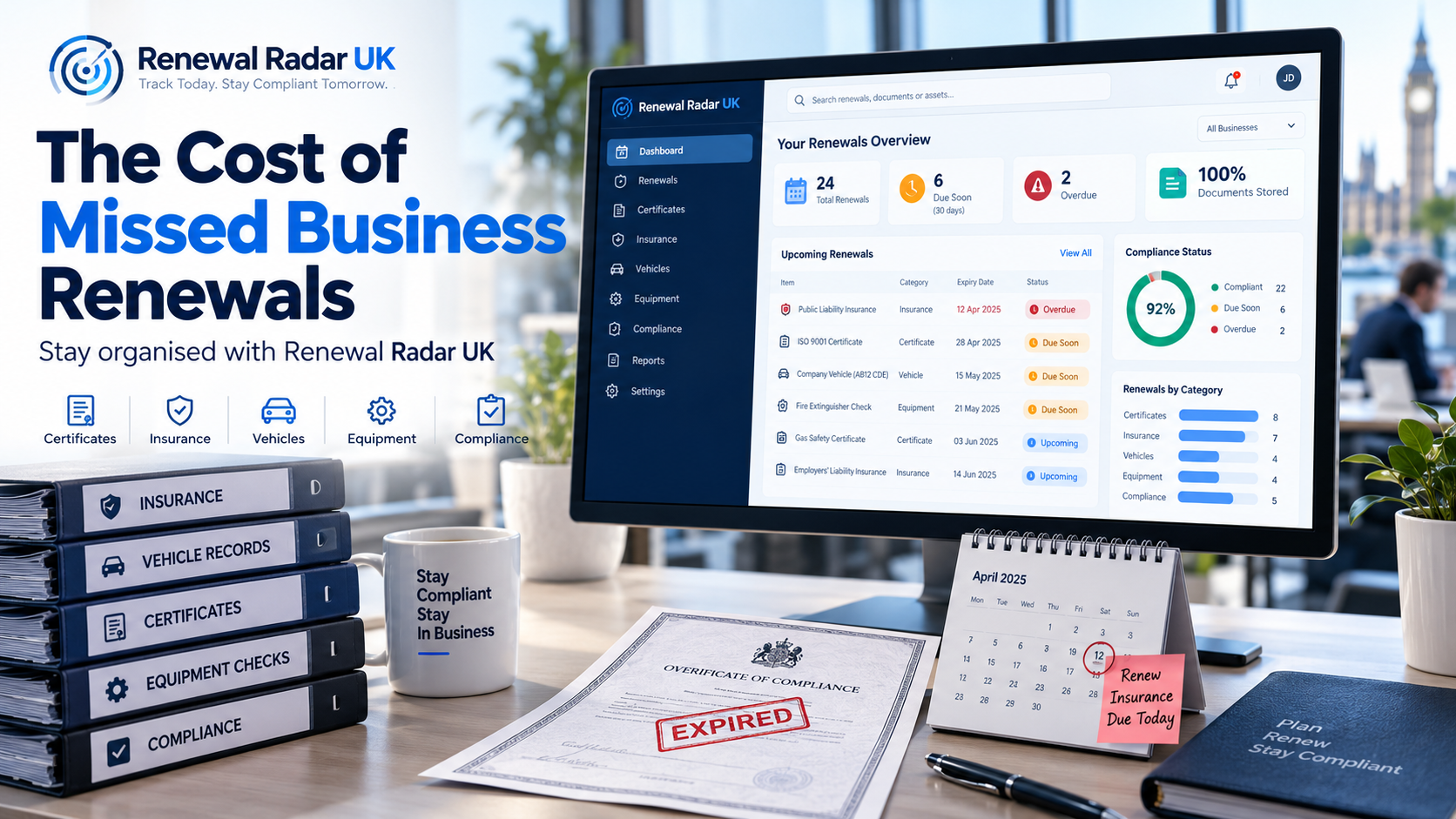
Renewal Radar UK has been developed to help businesses manage many of these challenges through one dedicated online platform.
Rather than relying entirely on disconnected spreadsheets, calendars and filing systems, businesses can use Renewal Radar UK to organise important expiry dates, maintain relevant documentation and monitor responsibilities across different areas of their operations.
The application includes a central dashboard, document management tools, workforce qualification monitoring, vehicle and equipment tracking, an Action Centre and business reporting functionality.
Its Action Centre is designed to highlight records that are overdue, approaching expiry or missing important information. This helps users identify which responsibilities may require attention.
The workforce and vehicle management sections provide dedicated areas for organising information that can otherwise become difficult to maintain manually.
Renewal Radar UK also supports a more structured approach to document management, helping businesses keep relevant records together.
The purpose is not to replace professional advice, statutory inspections or the responsibility to maintain accurate information. Instead, the system provides practical tools that can support better planning, organisation and visibility.
For businesses dealing with numerous important deadlines, this can make everyday administration more manageable.

Take Action Before a Missed Renewal Costs Your Business
The financial impact of an overlooked renewal can vary from a minor inconvenience to a serious operational problem. What makes these situations particularly frustrating is that many can be avoided through better preparation and clearer record management.
Insurance policies, employee qualifications, equipment inspections, vehicle documents and commercial contracts all deserve appropriate attention.
As a business grows, expecting one person to remember every important date becomes increasingly unrealistic.
A reliable renewal management process helps protect valuable time, supports operational continuity and gives businesses greater confidence in their administrative arrangements.
Renewal Radar UK offers a practical way to bring your important records and deadlines together within one organised system.
With a 14 day free trial, businesses can explore the platform and see how its features fit their everyday requirements.
Subscriptions are available at £49 per month, with an annual option of £490 offering a saving of £98 compared with twelve monthly payments.
Visit www.renewalradaruk.com to discover how Renewal Radar UK can help you organise essential business information, monitor important dates and take greater control of your renewal responsibilities.
Because the best time to deal with an important renewal is before it becomes an expensive problem.
All the best!
Eamon