
Managing employee qualifications, training records and professional certifications is an important responsibility for thousands of UK businesses. Yet keeping track of these documents can quickly become complicated, particularly when employees have different qualifications and renewal dates.
For construction companies, engineering firms, manufacturers, maintenance contractors and other organisations, knowing which employees hold the appropriate qualifications can be essential for safe and efficient operations.
Unfortunately, many businesses still rely on spreadsheets, paper certificates and scattered digital folders to manage workforce information.
As teams grow, these methods can become increasingly difficult to maintain. Certificates expire, employees undertake additional training and managers need access to accurate information.
This is why employee certification tracking is becoming an increasingly valuable part of modern workforce management.
With the right processes and digital tools, businesses can organise employee records, monitor certificate expiry dates and identify important training requirements before they cause operational problems.
What Is Employee Certification Tracking?
Employee certification tracking is the process of recording, monitoring and managing qualifications, licences, training certificates and other evidence of employee competence.
It helps businesses understand which workers hold particular qualifications, when those qualifications were obtained and whether renewal or further training is required.
For example, a construction business may need to manage records relating to plant operation, specialist trade qualifications, safety training and professional certifications.
A manufacturing company might track machinery training, technical qualifications and role specific authorisations.
Meanwhile, a facilities management business may need to monitor electrical qualifications, maintenance certifications and training relevant to its employees’ responsibilities.
Although the requirements differ between industries, the underlying objective remains the same.
Employers need reliable information about workforce qualifications and the ability to identify when action is required.
An organised tracking process makes this information easier to maintain and review.
Why Employee Certification Management Matters
Employee qualifications are not simply pieces of paperwork. They can provide important evidence of training, knowledge and professional achievement.
In some circumstances, holding a particular qualification or authorisation is necessary before an employee can undertake specific work.
However, employers must also consider competence more broadly.
The UK Health and Safety Executive explains that competence involves a combination of training, skills, experience and knowledge. Possessing a certificate alone does not automatically demonstrate that someone is competent for every task.
Businesses therefore need to understand both the qualifications required for particular activities and the wider skills necessary to perform work safely.
Accurate employee training records can support this responsibility by helping managers identify qualifications, relevant experience and areas requiring additional development.
They can also make everyday workforce planning more efficient.
When managers know which employees have particular capabilities, they are better equipped to allocate appropriate work and plan future training.
The Challenges of Managing Employee Certificates Manually
For a small business with only a few employees, keeping track of training certificates may initially seem straightforward.
However, imagine a company employing twenty workers, each holding several different qualifications.
Some certificates may require periodic renewal, while other training records may need reviewing when equipment, responsibilities or working practices change.
The business could quickly find itself managing dozens of separate records.

If those records are stored in spreadsheets, emails and filing cabinets, maintaining an accurate overview becomes difficult.
Managers may spend unnecessary time searching for documents, checking dates or contacting employees for missing information.
Problems can also arise when the person responsible for maintaining the records is absent or leaves the business.
Without a central system, essential workforce information may become difficult to locate.
These challenges demonstrate why businesses benefit from a consistent and organised approach to employee certification management.
Understanding Training and Competence Requirements in the UK
UK employers have important responsibilities regarding employee training and competence.
Under the Management of Health and Safety at Work Regulations 1999, employers must consider employees’ health and safety capabilities when allocating tasks.
The regulations also require adequate health and safety training when employees are recruited and when relevant changes expose them to new or increased risks.
Training must be repeated periodically where appropriate and adapted to changing risks.
This does not mean that every employee certificate automatically expires after a fixed period.
Some qualifications have specific validity periods established by issuing bodies or applicable schemes. Other training requirements depend on the type of work, equipment used and individual circumstances.
For example, additional training may be necessary when a worker begins using unfamiliar equipment, even if an existing certificate remains current.
Employers should therefore avoid assuming that every qualification follows the same renewal schedule.
A reliable certification tracking process should record the relevant requirements for each qualification and identify whether an expiry date, refresher training date or periodic competence review applies.
How to Create an Employee Training Matrix
One of the most effective ways to organise workforce qualifications is through an employee training matrix.
A training matrix provides a structured overview of employees and the qualifications or training associated with their roles.
Instead of examining individual certificates, managers can review information across their workforce.
A useful matrix should identify each employee, their role, relevant qualifications, training completion dates and any applicable expiry or review dates.
It should also highlight missing records or training requirements requiring attention.
For example, a construction company could use a matrix to compare the qualifications held by electricians, plant operators, supervisors and general site workers.
This helps managers understand where particular capabilities are available and where additional training might be necessary.
A training matrix can also support workforce planning.
If several employees require refresher training during the same period, the business may be able to organise sessions more efficiently.
However, a matrix is only valuable when the underlying information remains accurate. Regular updates and clear responsibility for maintaining records are essential.
Seven Steps to Better Employee Certification Tracking
Businesses can improve their workforce records by introducing a straightforward management process.
1. Identify Relevant Qualifications
Start by identifying the qualifications, certifications, licences and training requirements associated with each employee’s responsibilities.
Focus on the actual needs of the role rather than assuming every worker requires identical documentation.
2. Create a Central Employee Register
Maintain a clear record of employees, their roles and relevant qualifications.
A central register makes it easier to understand what information exists and where gaps may need investigating.
3. Record Important Dates
Include training completion dates, certificate expiry dates and relevant review requirements.
Remember that some training may require reassessment even when there is no formal certificate expiry date.
4. Organise Supporting Documents
Keep relevant certificates and training records in an organised location.
Where possible, ensure that authorised managers can retrieve necessary evidence without searching through numerous folders.
5. Assign Responsibility
Identify who is responsible for updating employee records and monitoring upcoming requirements.
Without clear ownership, important administrative tasks can easily be overlooked.
6. Review Records Regularly
Establish a suitable schedule for reviewing qualifications, missing documentation and approaching renewal dates.
The frequency should reflect the nature of your business and the significance of the relevant requirements.
7. Plan Training Before It Becomes Urgent
Arrange necessary training or reassessment with enough notice to avoid unnecessary disruption.
Some courses have limited availability, making early planning particularly important.
Following these steps can create a much more organised and dependable workforce management process.
Move Beyond Spreadsheets with Renewal Radar UK
Spreadsheets can provide a basic starting point for employee certification tracking. However, they often require considerable manual administration as a workforce expands.
Renewal Radar UK provides a dedicated online platform for businesses that want a more structured approach.
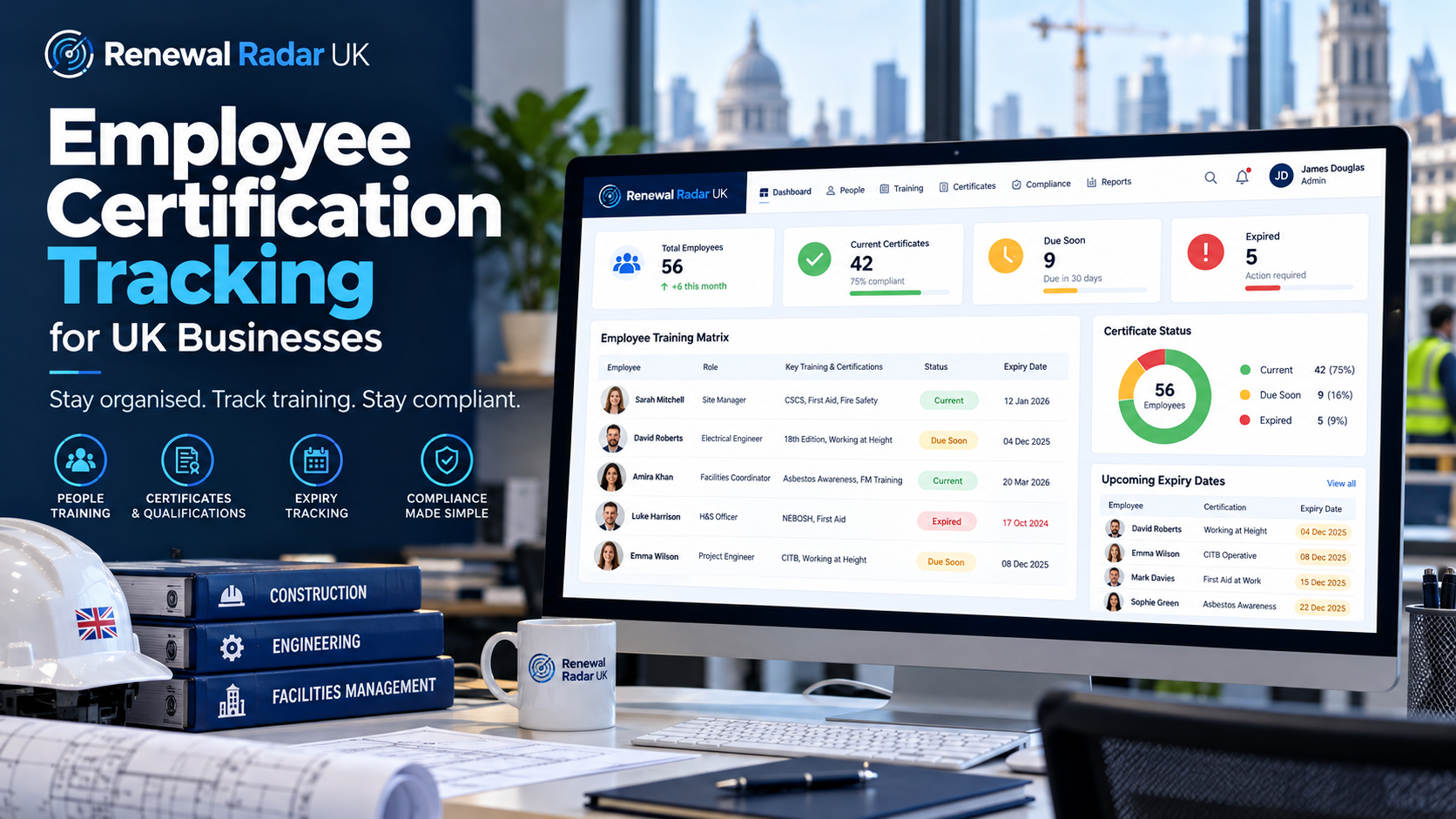
The application includes workforce management functionality and a workforce compliance matrix designed to help employers organise employee qualifications and related records.
Instead of managing workforce information entirely through disconnected spreadsheets, businesses can maintain relevant information within a central application.
Renewal Radar UK also includes document management facilities, renewal tracking and an Action Centre that helps identify overdue records, approaching expiry dates and missing information.
These features can be particularly useful for companies managing several employees with different certification requirements.
The platform does not replace professional competence assessments or an employer’s legal responsibilities. However, it can support better organisation and provide greater visibility over important workforce records.
Want to simplify employee certification tracking? Visit www.renewalradaruk.com and start your 14 day free trial to explore the workforce management tools.
The Benefits of Digital Employee Certification Tracking
Moving towards a central digital system can provide several practical advantages.
One of the most immediate benefits is improved access to information. Managers can work from an organised collection of employee records rather than relying on separate spreadsheets or individual email accounts.
Another advantage is clearer visibility over upcoming requirements.
When important dates are recorded consistently, businesses are better positioned to identify qualifications that may require renewal or further investigation.
Digital record management can also reduce repeated administration.
Instead of searching for certificates every time information is requested, businesses can maintain a more accessible collection of relevant documents.
Better workforce information may also support operational planning.
Managers can identify which employees hold relevant qualifications and consider upcoming training needs when allocating resources.
These benefits become increasingly valuable as organisations grow and workforce responsibilities become more complex.
Workforce Certification Overview
Example status of 60 employee certification records
Records approaching review or marked expired
Illustrative data for demonstration only. Certificate and training review requirements vary by role, qualification and applicable regulations.
Which Industries Benefit Most from Certification Tracking?
Employee certification management is particularly relevant to businesses where workforce qualifications and training have a direct relationship with operational activities.
Construction companies regularly manage different trade qualifications, specialist training records and evidence of competence.
Engineering businesses may need to maintain technical certifications and records associated with specialist activities.
Manufacturing companies often require appropriate training for employees working with machinery, equipment and production processes.
Facilities management organisations may employ workers carrying out electrical work, maintenance, inspections and other specialist services.
Transport and logistics businesses also benefit from maintaining appropriate driver and equipment training records.
Although these industries have different requirements, they share a common need for accurate workforce information.
A central certification tracking system can help each organisation develop a more consistent approach to managing its records.
Protecting Employee Information and Maintaining Accurate Records
Employee certification records often contain personal information, making appropriate data protection practices important.
Businesses should ensure that access to employee records is limited to authorised individuals who have a legitimate reason to view the information.
Records should be stored securely, kept accurate and retained only for appropriate periods.
The UK General Data Protection Regulation and Data Protection Act 2018 may apply to personal information held within workforce management systems.
Businesses should therefore understand their responsibilities when collecting, storing and sharing employee information.
It is equally important to maintain accurate records.
A document management system is only as reliable as the information entered into it.
Businesses should establish procedures for updating qualifications when employees complete training, change roles or leave the organisation.
Regular reviews help ensure that records continue to reflect the workforce accurately.
How Renewal Radar UK Supports Growing Workforces
As a business expands, the administrative challenge of monitoring employee qualifications increases.
A company with five employees may be able to manage its records manually. However, a business employing fifty workers across several locations may require a more structured approach.
Renewal Radar UK has been designed to help businesses organise important operational information within one online application.
Alongside its workforce compliance matrix, the platform includes a central dashboard, document management, reporting and renewal monitoring features.
This allows businesses to manage employee certification information as part of a wider business renewal process.
For example, a construction company may need to monitor workforce qualifications alongside vehicle documentation, equipment inspections and insurance policies.
Having these different responsibilities accessible through one platform can help reduce fragmented administration.
If your business is growing and workforce records are becoming harder to manage, Renewal Radar UK offers a practical way to bring important information together.
Explore the application with a 14 day free trial at www.renewalradaruk.com.
Common Questions About Employee Certification Tracking
Do All Employee Training Certificates Expire?
No. Not every employee training certificate has a fixed expiry date.
Requirements vary according to the qualification, issuing organisation, relevant regulations and nature of the work.
Employers should verify the requirements associated with individual qualifications and determine when refresher training or reassessment may be necessary.
1. Is an Employee Training Matrix a Legal Requirement?
There is no universal legal requirement for every UK business to maintain a document specifically called an employee training matrix.
However, employers do have legal responsibilities relating to appropriate training and competence.
A training matrix can be a useful management tool for organising evidence and identifying training requirements.
2. Can Small Businesses Benefit from Certification Tracking Software?
Yes. Even businesses employing only a handful of workers can benefit from maintaining organised qualification and training records.
A central system can become particularly valuable when employees undertake different activities or require several certifications.
3. How Often Should Employee Training Records Be Reviewed?
There is no single review interval suitable for every business.
The appropriate frequency depends on the work undertaken, relevant risks, qualification requirements and changes affecting employees.
Businesses should review records sufficiently often to identify important training needs and upcoming deadlines.
Take Control of Employee Certification Tracking Today
Managing workforce qualifications should not involve constantly searching through spreadsheets, chasing certificates or wondering whether important training records remain current.
With a clear management process, businesses can improve visibility over employee qualifications, plan training more effectively and maintain better organised records.
Renewal Radar UK brings workforce certification tracking, document management and important business renewal information together in one convenient online platform.
Its workforce compliance matrix helps businesses organise employee related records, while the dashboard, Action Centre and reporting facilities provide additional tools for monitoring important responsibilities.
Whether you manage a small team or a growing workforce, having reliable information readily available can make everyday administration significantly easier.
Start Your 14 Day Free Trial of Renewal Radar UK
Discover how Renewal Radar UK can help your business manage employee qualifications and essential documentation more efficiently.
Choose the monthly subscription at £49 per month, or select the annual option at £490 per year, saving £98 compared with twelve monthly payments.
Start with a 14 day free trial and explore the application before deciding which subscription suits your business.
Visit www.renewalradaruk.com today and discover a smarter approach to employee certification tracking.
Renewal Radar UK. Better Records. Clearer Responsibilities. Greater Control.
All the best!
Eamon