

Welcome to Renewal Radar UK and out article on How To Organise Business Documents and Expiry Dates. Operating a business means dealing with paperwork. There are insurance certificates to keep safe, employee qualifications to monitor, contracts to review and important documents that need renewing. Some are used regularly, while others might sit untouched for months until somebody suddenly needs them.
The problem is rarely a lack of information. Most businesses have the documents they need somewhere. The difficulty is knowing exactly where everything is, whether the information is still current and when something requires attention.
Perhaps an insurance certificate is buried in an old email. A training record might be saved on an employee’s computer, while an equipment inspection report is sitting in a filing cabinet at another location.
These situations are familiar to many business owners, and they become increasingly common as companies grow.
The good news is that organising your business documents does not need to be complicated. With a sensible system and a little consistency, you can make important information easier to find, keep track of expiry dates and spend less time dealing with unnecessary administration.
Why Business Document Management Matters
Good document management is about much more than keeping a tidy office. It helps businesses work efficiently, respond to requests for information and maintain better control over important responsibilities.
Consider how often documents are needed during normal business activities. A customer might request evidence of public liability insurance. A principal contractor could require employee qualification records, while a manager may need to check an equipment inspection report before arranging work.
When those documents are organised and readily accessible, responding is straightforward. When they are scattered across different locations, even a simple request can turn into a frustrating search.
Poor document management also makes it easier to overlook important dates. A contract may contain a notice period that nobody remembers, or an insurance policy could approach renewal without anyone realising.
Maintaining accurate records and knowing when they require attention can help prevent these avoidable problems.
For smaller businesses, the benefits often involve saving time and reducing administrative frustration. For larger organisations, effective document management becomes an important part of coordinating information across employees, departments and locations.
The Problem With Traditional Filing Systems
There is nothing inherently wrong with keeping paper records. Many businesses still maintain physical documents for perfectly sensible reasons. Problems arise when paper files, digital folders, email attachments and spreadsheets are all used without a consistent approach.
Imagine a construction company that has been trading for fifteen years. Over that time, it has accumulated hundreds of documents relating to employees, machinery, vehicles, insurance and commercial contracts.
Some paperwork is stored at the office. Other records are held by individual managers, and electronic copies may be scattered across several computers.
Finding a particular certificate might involve contacting several employees or searching through years of emails.
The difficulty becomes even greater when someone leaves the business or a document is needed urgently.
A better approach is to establish a central location for important records, supported by clear categories and consistent naming conventions.
This makes information easier to locate and reduces reliance on individual employees remembering where everything is stored.
Start by Identifying Your Essential Business Documents
Before introducing a new filing system, it helps to understand exactly what needs managing.
Most businesses have several categories of important documentation, although the specific requirements depend on their industry and activities.
Insurance documents are an obvious starting point. These may include public liability insurance, employers liability insurance, professional indemnity cover and other relevant policies.
Employee records are another important category. Depending on the business, these could include professional qualifications, training certificates, licences and relevant evidence of competence.
Companies operating vehicles or machinery may also need to maintain MOT records, insurance documents, inspection reports and equipment certificates.
Commercial documentation should not be overlooked. Supplier agreements, service contracts, software licences and professional memberships may all contain important renewal or review dates.
Once you identify the documents that matter to your business, you can begin organising them into a clear and manageable structure.
The aim is not to collect unnecessary paperwork. It is to make sure that important information can be found and reviewed when required.
Create a Clear Document Filing Structure
One of the simplest ways to improve business document management is to establish consistent categories.
Rather than keeping everything inside one large folder, divide documents into meaningful groups. For example, insurance records could be stored separately from employee qualifications, vehicle documents and commercial contracts.
Within each category, records can be organised further according to the needs of the business.
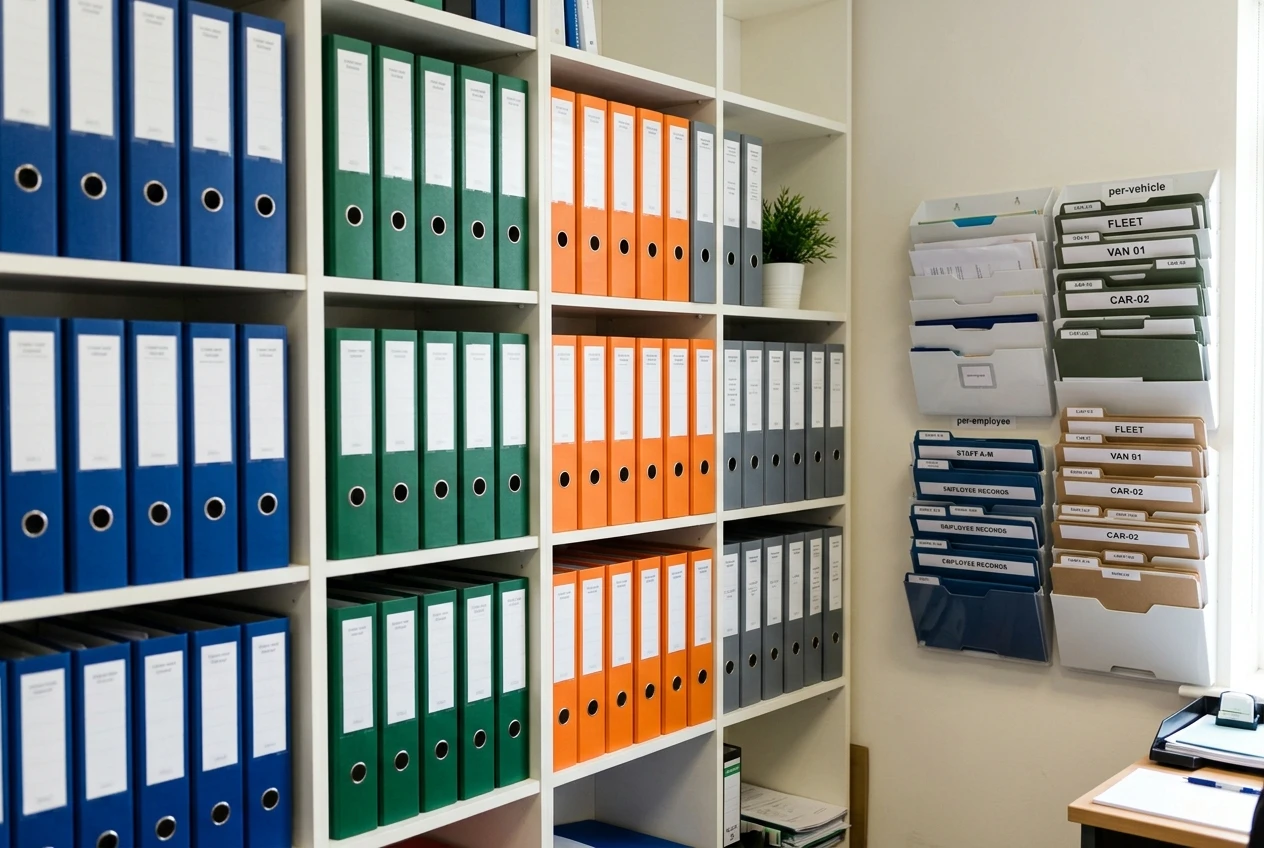
A company managing several vehicles might keep a separate record for each vehicle. An employer could organise workforce certificates by employee, while a facilities management business might prefer to group certain documents by building or site.
The important thing is consistency.
If one employee saves a certificate under a person’s name while another uses the document type, finding information becomes unnecessarily difficult.
Document names should be clear enough that somebody unfamiliar with the file can understand what it contains.
It is also worth avoiding confusing versions of the same document. Outdated records should be handled appropriately so employees can distinguish current information from historical copies.
A well organised system should make sense to the people who use it every day.
Record Expiry Dates Alongside Your Documents
Storing documents is only half the challenge. Many important business records have expiry dates, review periods or renewal requirements.
An insurance certificate might be valid for twelve months, while certain employee qualifications remain current for several years. Commercial agreements may have renewal dates or contractual notice periods that require attention much earlier.
Simply saving a document does not mean these dates will be remembered.
A more effective approach is to record the relevant information alongside each document.
Useful details include the document name, associated employee or asset, relevant expiry date, person responsible and any action that needs to be completed.
For contracts, it may also be necessary to record notice periods or review dates separately from the actual renewal date.
Not every document has a formal expiry date. Some records instead require periodic review, particularly where training, equipment condition or operational circumstances may change.
Understanding the difference between expiry dates and review requirements helps businesses create more accurate tracking arrangements.
The goal is to make important dates visible before they become urgent.
Business Document Status Overview
Example business managing 80 important records
Stay Ahead of Important Renewal Dates
Renewal Radar UK helps you organise important documents and identify records requiring attention.
Illustrative figures only. These are not actual customer results or software performance statistics.
Do Not Wait Until the Expiry Date to Take Action
One common mistake is treating the expiry date as the day when renewal arrangements should begin.
In reality, some renewals require considerable preparation.
An employee may need to attend training before a qualification can be renewed. Equipment examinations might depend on the availability of a competent person, while an insurance renewal may involve reviewing quotations and confirming that the policy still provides appropriate cover.
Contracts can be even more complicated if they contain notice periods or require advance decisions.
Businesses should therefore identify when action needs to begin, rather than simply recording the final deadline.
For example, a qualification expiring in three months might require arrangements to be made several weeks beforehand.
The appropriate amount of notice depends on the requirement and the time needed to complete the necessary work.
Regularly reviewing upcoming dates allows businesses to plan renewals around other commitments and reduces the likelihood of last minute disruption.
How Renewal Radar UK Simplifies Document Management
For businesses managing large numbers of documents and renewal dates, maintaining everything manually can become a considerable administrative burden.
This is where a dedicated business renewal management system can be particularly useful.
Renewal Radar UK is designed to help businesses organise important documents, track expiry dates and maintain clearer visibility over essential operational responsibilities.
The online application includes document management functionality, a central dashboard, workforce records, vehicle and equipment management, reporting tools and an Action Centre that highlights important items requiring attention.
Rather than relying entirely on scattered spreadsheets and separate filing systems, businesses can maintain relevant records within one organised application.
This is particularly useful when documents relate to different parts of the business. Employee qualifications, equipment inspection records, insurance certificates and other important information can be managed through a more consistent process.
The platform is designed to support better organisation, not replace the responsibility to maintain accurate documents or complete required renewals.
Want a simpler way to organise important business documents and monitor expiry dates? Visit www.renewalradaruk.com and start your 14 day free trial to explore how Renewal Radar UK could work for your business.
Make Document Responsibilities Clear
Even a well organised filing system can become unreliable when nobody knows who is responsible for maintaining it.
This is particularly important in businesses where several employees share administrative duties.
For example, an office administrator might manage insurance documents, while a site manager oversees equipment inspection reports. Employee qualifications may be handled by another member of the team.
These arrangements can work well, provided responsibilities are clear.
Every important document category should have an appropriate person responsible for keeping records current and identifying necessary updates.
Businesses should also decide who reviews upcoming deadlines and who confirms that renewals have been completed.
When responsibilities are unclear, tasks can easily be overlooked because everyone assumes somebody else is dealing with them.
Clear ownership helps create accountability and makes document management more dependable.
Keep Your Business Documents Accurate and Current
A document filing system should never become a place where information is uploaded and forgotten.
Business records change constantly. Employees complete training, insurance policies renew, contracts are replaced and equipment undergoes further examinations.
Without regular updates, even an impressive digital filing system can quickly become unreliable.
Businesses should develop straightforward procedures for adding new documents and reviewing existing records.
When an insurance policy renews, for example, the current documentation should be recorded and the relevant renewal information updated.
Similarly, when an employee completes additional training, the appropriate qualification record should be reviewed.
It is also important to retain historical records where necessary, rather than deleting information that may be required later.
A consistent review process helps ensure that employees are working with reliable information and that important dates remain visible.
Protecting Confidential Business Information
Many business documents contain information that should not be available to everyone.
Employee qualifications may include personal details, while commercial agreements can contain confidential financial or contractual information.
Businesses therefore need to consider security when organising digital records.

Access should be limited to authorised individuals who need the information for legitimate purposes.
Strong account passwords, appropriate access permissions and reliable backup arrangements are sensible measures for protecting important data.
Where personal information is involved, businesses should also consider their responsibilities under applicable UK data protection legislation.
Documents should be retained for appropriate periods and disposed of securely when they are no longer required.
A central document management system can make organisation easier, but businesses must still establish suitable policies for protecting the information they hold.
Why Spreadsheets Eventually Become Difficult to Manage
Spreadsheets remain popular because they are familiar, inexpensive and easy to set up.
For a small business managing only a few renewal dates, a spreadsheet may initially be perfectly adequate.
However, difficulties often emerge as the number of records increases.
Employees may create different versions of the same spreadsheet, making it unclear which contains the latest information.
Some records may be updated while others are overlooked, and important dates can become buried among hundreds of rows.
Spreadsheets also depend heavily on consistent manual input and regular checking.
As businesses expand, these limitations can create unnecessary administrative work.
A dedicated renewal management platform offers a more structured way to organise information and identify records requiring attention.
The most suitable solution will depend on the business, but it is worth reviewing existing processes when document management begins consuming too much time.
The Benefits of Having Everything in One Place
Centralising important business documents can make a noticeable difference to daily operations.
One of the most obvious benefits is convenience. Employees can spend less time searching for information and more time dealing with the work that matters.
There is also greater clarity. When records are organised consistently, managers can understand which documents exist, where information is stored and which responsibilities require attention.
Centralised document management can support business continuity as well. If an employee leaves or changes roles, essential information is less likely to become inaccessible.
For growing companies, this becomes increasingly valuable.
Another advantage is improved preparation. Having important expiry dates and relevant documentation readily available makes it easier to review upcoming renewals and arrange necessary action.
Although better organisation cannot guarantee that every deadline will be met, it provides a much stronger foundation for managing important business responsibilities.
Building a Document Management Routine That Lasts
Introducing a new document management process is only the beginning. The real challenge is maintaining it consistently.
Businesses should establish a routine that suits their size, activities and level of administrative complexity.
For some organisations, a regular weekly review may be appropriate. Others might need more frequent checks because they manage numerous employees, assets or contracts.
The review should focus on upcoming dates, missing information, recently renewed documents and records requiring investigation.
New employees, vehicles, equipment and contracts should also be added to the system promptly.
It helps to keep the process straightforward. A complicated filing procedure that nobody follows is unlikely to provide lasting benefits.
The most effective system is one that employees understand and can maintain without unnecessary effort.
Over time, consistent habits can turn document management from a frustrating administrative task into a normal part of running the business.

Better Document Management Supports Business Growth
As businesses expand, administrative responsibilities rarely become simpler.
More employees mean additional training records and qualifications. More equipment introduces further inspection requirements, while new customers and suppliers often bring additional contracts and documentation.
Without a structured approach, these growing responsibilities can place increasing pressure on the people managing them.
Establishing a reliable document management process early can help businesses prepare for expansion.
New records can be added to an existing structure rather than creating additional spreadsheets and filing systems.
Managers also benefit from having a clearer overview of important business information.
This does not remove the need for responsible management, but it can make the administrative side of growth considerably easier.
For ambitious businesses, organised information is an operational advantage worth developing.
Take Control of Your Business Documents and Renewal Dates
Running a business involves enough challenges without wasting valuable time searching for missing certificates, checking scattered spreadsheets or worrying about forgotten renewal deadlines.
A better approach begins with understanding which documents matter, organising them consistently and establishing clear responsibilities for maintaining accurate records.
Businesses should also monitor important expiry dates, identify when renewal action needs to begin and review their information regularly.
These simple practices can reduce unnecessary administration and provide greater confidence that essential responsibilities are being managed.
Renewal Radar UK brings business document management, expiry date tracking, workforce records, vehicle and equipment information and important renewal responsibilities together within one online platform.
Its central dashboard, document management features, Action Centre and reporting tools are designed to help businesses organise information and identify records requiring attention.
Start Your 14 Day Free Trial of Renewal Radar UK
If you want to move beyond scattered documents, confusing spreadsheets and forgotten renewal dates, Renewal Radar UK offers a practical way to bring your important business information together.
The platform is available for £49 per month, with an annual subscription option of £490 per year, saving £98 compared with twelve monthly payments.
You can explore the application through a 14 day free trial and discover how its features could support your business.
Visit www.renewalradaruk.com today and start taking greater control of your business documents, expiry dates and important responsibilities.
Renewal Radar UK. Better Organisation. Clearer Deadlines. Greater Control.
All the best!
Eamon